Book Review and Notes: Tiny Experiments by Anne-Laure Le Cunff
Tiny Experiments. Have you read it? I heard about this book a while ago and decided to add it to my TBR. As someone who loves to read and has been devoting more time to it over the past couple of years, it just somehow seems like the right books come to you at the right time.
I started building a personal curriculum this year and put this book in my “Conscious Living” module (more on that later…but sooner rather than later, if you’re interested in hearing about it).
I saw the audiobook on sale and bought it. Instant regret. When it comes to nonfiction - especially good nonfiction - I tend to want to highlight and bookmark things, which is a serious disadvantage with audio (in my opinion). So, a few chapters in, even though Le Cunff is a great narrator of her work, I had to pause. I searched four libraries for the book, and a few online used bookstores. None had it.
Admittedly, I got antsy, and eventually walked over to my local indie bookstore and grabbed a copy off the shelf. I kept walking, straight to a local cafe, whipped out my highlighters, cracked open the book and cranked through it until I got to the end. It’s an easy read, clearly written - and includes an extensive glossary and a long list of references (the author is a scientist, after all) at the end.
About the Book:
Planning and productivity have been a large part of my career for almost 20 years now, but there’s always been a little something that didn’t feel quite right to me about the productivity industry to me. I think it’s because I’ve always been slightly averse to hustle culture, and I am even more turned off by it these days.
Tiny Experiments by Anne-Laure Le Cunff is about creating pacts with yourself - tiny experiments - that are more focused on doing, exploration, and learning than on placing your hopes on a hard outcome. Example: Many books and courses will throw a plan in front of you to get 1,000 followers in 30 days. In contrast, Tiny Experiments’ framework would invite you to “publish a new video on YouTube Shorts once a week for 8 weeks” or “write a blog post every day for 30 days.” Less “lose 10 pounds in a month” and more “I will walk for one hour every day for two weeks.”
I will [action] for [duration].
The focus is simply on “did you do it or not?” But you take what you learn and adjust - perhaps you extend the experiment. Maybe you tweak it. Maybe you do something else all together. It’s an experiment and you leave yourself open to see what happens.
That in and of itself feels like so much less of a burden than the goal setting methods we’ve grown accustomed to.
My Experience and Practical Application:
It’s funny how reading and the entire experience around it can teach you so much. I’m reconfirming the best ways for me to consume (book) content. Print reigns supreme, digital is close behind, and audio pulls up the rear because there are only certain things that work well for me on audio.
I am also the QUEEN of keeping my books pristine (washing my hands to get any lotions off, taking the jacket off hardcovers, using a book pouch). I am VERY precious about my books. Taking this book straight to a cafe, plopping down at a shared table and HIGHLIGHTING the heck out of a book (something I haven’t done since college) felt…freeing?
I also recently saw a reel on Instagram where a guy was talking about why he loved used bookstores - he loves seeing the notes and thoughts of people as they read their books. I always search for the most pristine copy I can get my hands on and though I don’t think I’ll go as far as him, I did begin to think, “who cares if I wrote in it? Who does it ACTUALLY matter to?” Obviously not me and maybe not the person who (potentially) acquires this book somewhere after I’ve died (I wasn’t sure if I’d even like this book, but once I sat down with it, it felt like a keeper).
I still pop my book in a pouch when it leaves the house with me - I am who I am - but it feels good to live in a book again.
I attempted to create some experiments while reading - I mean the formula was just so simple. And while it was great to have those experiments in mind, ultimately, I feel better equipped to start now that I’ve finished the book.
I’ve chosen my first four experiments. The book doesn’t tell you a number you should have, but this felt right to me, given what’s been on my mind lately. They range in length: The shortest one is one week. The others range from 10 to 30 days. This is the only way I felt comfortable juggling so many at a time when trying a new methodology.
I made a simple tracker, stuck it in my daily planner and I’m ready to kick things off. I’m also proud of myself on that front as well. It’s very easy for me to get distracted or frustrated in my lack or artistic skill (no fancy spreads or beautiful sketches around here!). But I was determined to start my experiments ASAP - something touched on a little bit in the book, but a general idea I’ve found helpful for the last few years. The longer you wait to start, the less likely it is that you will. So, I used what I had - a thermal label printer and a template I found on Canva. Tweaked the header, printed it, and stuck it in my planner with washi tape. It’s a tiny experiment in and of itself. Now that I’ve done it this way, I also kind of love it because I can move the tracker week to week or even day to day if I want to. I don’t have to flip back to access it every day.
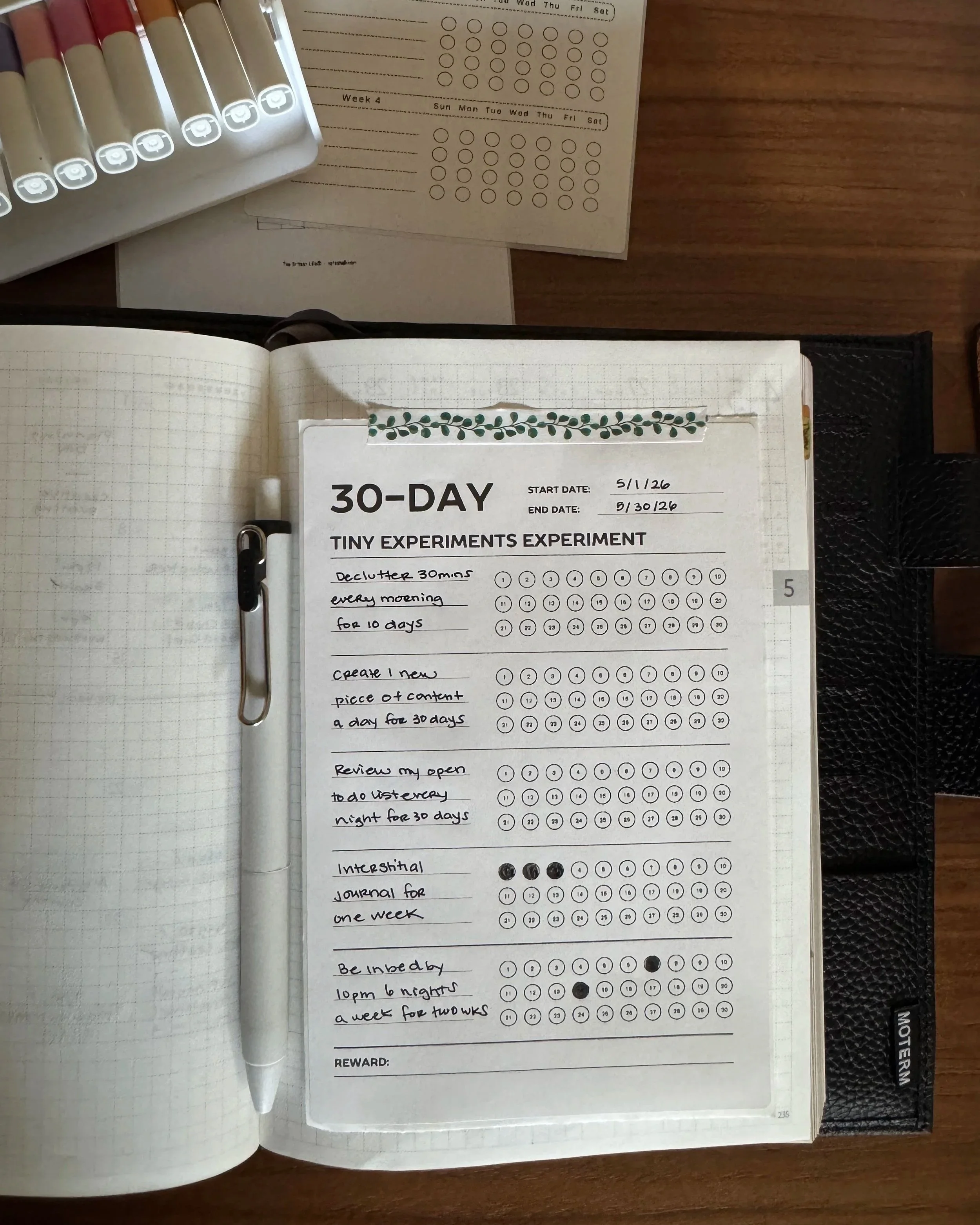
A simple tracker template I utilized to track my tiny experiments
—
If you’re interested in learning more about yourself and being open to opportunities in any area of your life (your experiments are yours - they can be recreational, personal, social, etc), I highly recommend this book. I’ll be sharing updates on my experiments here and on social. Feel free to drop a comment below or connect via social if you’re running your own Tiny Experiments. I’d love to hear about it!